Multiple Hole Beads, Anyone?
By Hannah Rosner, for Artisan Jewelry Times 2016
Two, three and four hole beads have recently taken the beading world by storm, but they are not a new concept. It all started for me with Twins and SuperDuos , two types of diamond shaped beads each with two holes in them, but it turns out two hole beads were around long before then.
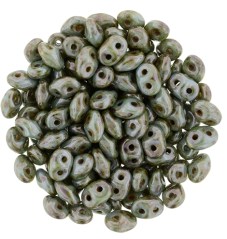
Now, every time I turn around, I have a new shape and finish of these mainly Czech-designed beads with which to play. As a result I sat down for short interviews with two experts on two-hole beads, Perry Bookstein and Nichole Starman.
Perry Bookstein’s family owned York Novelty Imports, located in the garment district in Manhatten, New York City. He grew up surrounded by the fashion industry and the beads his family imported from Europe, and now works for as a Product Manager for Beadsmith, a prominent bead wholesaler in New Jersey. As a result, I began by asking him to tell me a little bit about the history of multi-hole beads.
Hannah: Before the SuperDuos and the Twins, I’m sure that York Beads saw many types of two-hole beads. Your store (York Novelty Imports) carried both vintage and modern beads. Can you tell me about some of the two-hole beads that York stocked before the Twins and SuperDuos came onto the scene?
Perry: The previous explosion of multi hole glass bead came in the late 1800’s with the production of nail head beads. These beads were molded in glass using graphite and nickel molds. They were two holed, flat on the back and faceted on the front. Today this type of facet is referred to as an antique cut bead. These were made for the clothing industry. At that time, France ruled fashion. By the roaring twenties so many of these beads had hit the market, they were also applied to handbags and jewelry. During this time the French steel cut beads, a much sought-after and rarer bead material, were produced in both seed bead shapes and in the two-hole nailheads. World War II somewhat wiped this trend off the map as beads went into storage and fashion took a back seat, but the post-war Garment district in NYC kept nailheads in our beading vocabulary and in our inventories.
During the eighties (1980s) and nineties not many two hole beads were being imported to the United States. At that time, simple stringing reigned in the American bead world.. Once the multi hole beading market took off, the historical nailhead beads were studied to see which shapes made sense.
Hannah: Why do you think the Twins and SuperDuos took off so well? Was it marketing, or something else?
Perry: Actually, Twin Beads were a Czech bead company called Preciosa’s response to the Tila, a two-hole bead produced by a Japanese company called Miyuki. The Tila was basically a little square bead with two parallel holes running through its length. Both of these shapes took off due to the increased popularity in seed bead craft. Unlike the earlier beadwork that had been pushed by the fashion industry, there was more of a DIY (Do It Yourself) interest in jewelry. In this rare case, the beads pushed the boundaries and exploration in dimension and string path without being held back by a particular fashion need and use. Instead, there was unlimited potential for creativity.
As you know, Hannah, besides making new interlocking shaped designs, these beads created a phenomenon that brought the bead world closer together, both within the US and internationally. The two hole beads are often referred to as seed beads, even though many of them, including the best-selling one of them all (the Superduo) are actually pressed beads. The pinched shape of the Superduo was molded so perfectly by its creator, Daniel Matura, that it created a bead which could be seamlessly stitched with only minimal gaps. I think that, like everything else in the world from phones to sodas, marketing was based solely on success.
Hannah: Tell me a little more about the changes in bead marketing.
Perry: My grandfather, Sol Bookstein, started York Novelty Import Inc in 1924. Our company was an offshoot of the Garment District Era in New York City and we supplied many big names in fashion and accessories. When the Berlin Wall came down on June 12 1987, new waves of international business emerged in Eastern Europe. Along with these changes, there were technological breakthroughs and the methods of distribution began to change. The landscape of how to distribute, now worldwide, needed high end websites and sophisticated warehousing techniques.
The Starman brand of CzechMates beads, a two-hole beading system defined by a uniform placement of two or more equidistant-holes, adds an element of versatility never seen before in the beading world. As a Starman Beads Trendsetter, I have invested interest in using and designing with these multiple hole beads. Nichole Starman Director of Starman Beads, has been designing Czech glass bead shapes and colors for over a dozen years. Her architectural beadweaving designs show a huge range of textural and sculptural possibilities with these two-hole beads.
Hannah: I first became aware of the CzechMates two-hole system in 2013, just before I became a TrendSetter. When and how was the system first designed?
Nichole: Almost any Czech bead can be reproduced with two holes instead of one, but the results aren’t always practical. My goal is to create beads that artists can use as tools for making their own unique designs.
The Starman factory (in the Czech region of Bohemia in Eastern Europe) has thousands of different mold shapes in its archives, including 2-hole beads. I was fascinated by them, but I was limited in what I could produce since most beaders I spoke to did not see a use for them beyond stringing. I developed the 2-hole Tile in 2010 and started to experiment with new stitch paths that took advantage of the second hole. I found that the flat surface of the Tile was a great foundation to build and embellish upon. During this time, I was also developing the Brick and Lentil as complementary shapes with compatible hole spacing. I noticed their resemblance to materials commonly found in the construction of buildings, which fueled my desire to create a dimensional beading system.
Multi-hole beads have gained momentum over the past six years as they continue to be integrated into seed beadwork. These beads not only create structure and support, but they also make it easier for designers to integrate asymmetrical shapes into their designs.
Hannah: Tell me about how you design the new beads. Do you come up with a bead first, or a design that requires a new shaped bead?
Nichole: The most commonly used seed beads and shaped beads have the hole through the center and they look the same no matter how they spin on the thread. This gives designers control over the final look of their piece from every angle, but can be limiting dimensionally. Shapes that have an unbalanced weight distribution, like triangles, flat squares, and crescents used to be avoided because of their tendency to flip and dangle in unmanageable ways. Adding a second hole to these shapes made it possible to anchor them into place, giving artists more control over their positioning within a design. I take this into consideration when planning for new beads.
I get inspired by reading books on architecture and observing historic structures in cities, especially Prague. Bridges and skyscrapers are created with very simple components. As with creating jewelry, the structural integrity of each building is determined by how the individual pieces are positioned and how they are all connected together. I look at the vaulted masonry of gothic cathedrals as well as the steel frame construction of bridges for ideas when determining which attributes would be good to incorporate into new beads within the CzechMates system. Once I have a concept in mind for a bead I can visualize ways it can be combined with the other CzechMates shapes to create a new texture and dimension within designs. I try not to think too far ahead about creating specific jewelry designs, otherwise it’s easy to get overly excited about a shape that may have limited uses beyond the one design. Once a new bead shape has been created I almost always find myself using it in ways I never imagined.
Hannah: Tell me about the Trendsetters program and how you originally came up with the idea.
Nichole: After designing for a year I realized that I couldn’t continue alone. The beads were gaining popularity and the demand for more instructional designs was growing. Many talented designers began to emerge with their own new techniques. I invited a few select designers to participate in the first TrendSetter design team in 2012. Each team member gets the opportunity to work with prototype shapes before the beads are released to the public. This has become a tradition that continues even now that the team has expanded to include nearly fifty designers representing all forms of seed beadwork from around the world.
Hannah: My thanks to you both for your time.
Below, I’ve added some photos of my work using two hole beads. For more information about how Czech beads (both single and multi-hole) are produced, take a look at the Starman Beads website: http://beads.starmanwholesale.com/AboutUs/ManufacturingInformation.aspx
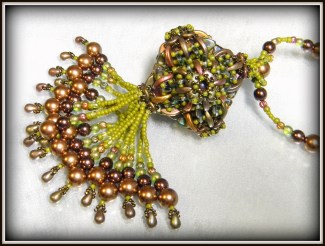
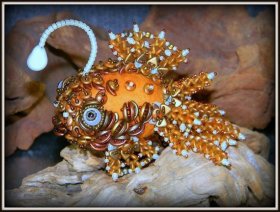
 Hannah Rosner Designs
Leave a comment